On using Jules and making my own interface to it
Here's Jules, a tool from Google roughly in the spirit of Codex or Claude Code for Web. Over a week or so of using Jules, I've been struck by two aspects of it in particular:
It's more proactive than other tools: after I connected a repository, it searched through it and made some uncontroversially beneficial fixes with almost no input required from me.
It's more scriptable and API-accessible than other tools.
In each of these respects, I'd guess that Jules is going in the right direction, and that other tools both will and should follow it. That's not to say that Jules is totally unique: it has plenty of overlap with, e.g., scheduled threads in the new Codex app or in various autonomous agents. But Jules is (I think!) unique in emphasizing these while maintaining a standard-ish Web-interface-to-asynchronous-cloud-tasks experience.
A few more notes about Jules:
- Unsurprisingly, I'm impressed by the quality of the code it produces.
- There are plenty of bugs and rough edges. This is largely a good thing, because I'd rather use an imperfect Jules than be waiting for a more polished one. This is just part of using tools in fast-paced, high-stakes times.
- I much prefer using the Jules Web interface on a larger screen, because there are so many elements in the Web interface: a list of tasks and a large panel with code, but also various documentation and feedback links, a safety warning, and more. On my main (13") laptop, that doesn't leave much room to actually talk with Jules.
- That, too, strikes me as a forward-thinking and structurally correct approach to the interface for these tools. I tend to want much more than what, e.g., Claude Code for Web shows me when I log in (that is, mostly a large empty box where a scrolling list of events might eventually be). I admire the clean minimalism of that experience, but for a command center, I just want more.
After a couple hours of using Jules, I couldn't resist putting a few facts together:
- Jules was powerful and useful; and
- I liked the busier, command-center-type interface; but
- I'd have preferred a different busy interface; but
- Jules has a good API, and
- I have a bunch of excess magic that is ideally suited for turning an API and some desires into an interface satisfying those desires.
So: I asked Claude to build me a local front end to Jules that kept what I found most useful, added some elements I wanted, and felt a bit more calm and intelligible. I'm finding it useful:
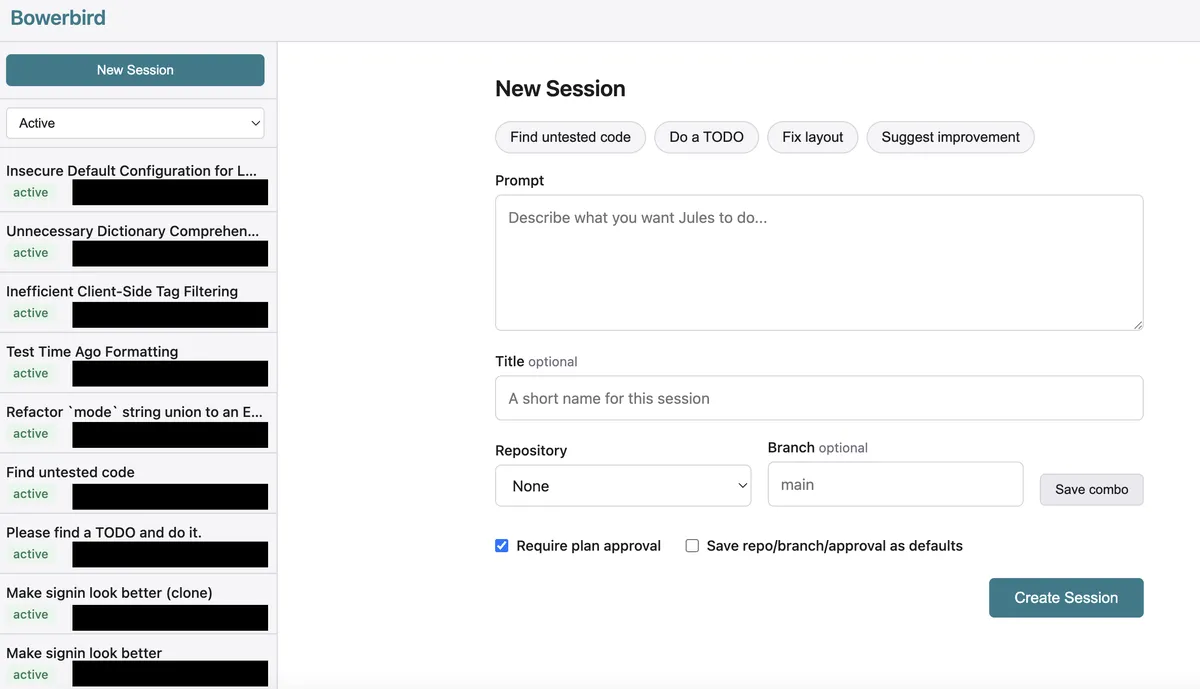
A few meta-level notes:
- There are UI elements I wouldn't have thought to add if I hadn't actually started building it. I'm always struck by how much occurs to me in building and using something that doesn't occur to me in planning, even if I try to be quite thoughtful about the planning.
- It's never easy to guess where equilibria will be, but I'd guess there's a future for highly customized interfaces to tools that offer APIs. YNAB, for example, has quite wonderful interfaces, but complicated ones, and some users might like stripped-down YNAB experiences in the spirit of "here are the six things you do in a way that makes sense to you."
- I find it amazing that (i) this type of tool is the focus of attention, (ii) Google has a very interesting offering of the type, and (iii) it's not drawing too much attention. My preferred explanation for this is simply that there's so much else going on; these are remarkable times.