What might an AI-first recipe site look like?
The near future will have AI-native versions of just about everything. I want to know more about what that will look like, and I want a clean modern recipe site for my own use, so I made one.
The core is simple:
- You can add new recipes and edit recipes you have.
- You can, optionally, keep track of times you made the recipe. (Sometimes I want notes about a recipe and also about a specific instantiation of it.)
- You can do simple searches for recipes.
But there's also an API intended to expose safe operations to AI tools:
- You can retrieve all your recipes, retrieve a single recipe by its ID, and do other
GEToperations. - You can also propose candidates for new recipes and for editing recipes you have. This is a pattern I've used elsewhere for AI-first APIs. Don't let them mutate data but do let them propose mutations, and give the user a good Web interface for accepting or rejecting the AI's proposals.
Now, "how do we expose API operations safely?" is a well-studied question, with many answers other than "only expose (relatively) safe operations." It's "what does an AI-first API look like?" that is newer (not new, but newer). I could have made other choices: two obvious ones are fine-grained permissions control per API key (think AWS) and various complicated MCP-based solutions.1
Whether or not this is a reasonable first pass at a solution, I think this is at least the sort of question I'll be thinking about much more as a practitioner of The New Programming.
The tool is, for me, useful in a way that feels surreal for a project like this:

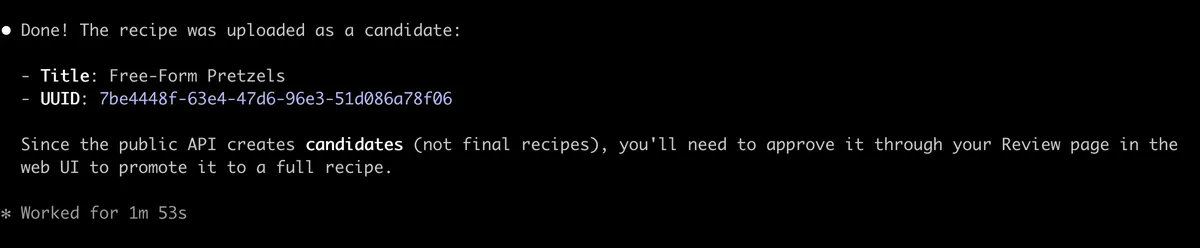
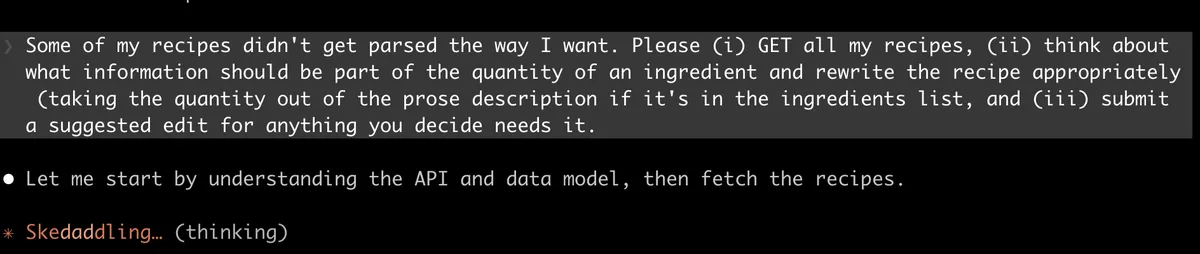
In minutes, I've made serious progress on my long-outstanding project of collecting and standardizing all my scattered recipes. It will be great fun to ask AI to go through my Gmail archive, standardize all the recipes, and submit them to me for review.
Here are some other notes on the process:
- The project has so far taken perhaps high tens or very low hundreds of minutes. This is hard to estimate because there's so much context switching.
- The estimate also doesn't count the time I spent improving my bootstrapper. I've tried to bake productionization in as much as possible, including a separate development environment and reasonable narrow- and wide-scope tests.
- Users can also test things out in the test environment at recipes-test.natemeyvis.com, because why not?
- The site doesn't have social features, and I expect it never will. They add complexity and are hard to moderate, but more relevantly here: your agent can do most of the social stuff for you! Even if you're not an AI power user, it shouldn't be very hard to ask for a JSON dump and then have your agent upload them. Browsing is important for recipes, but the whole extant Internet (plus whatever AI can think up) is already effectively browsable for you. Just ask the AI to do it.
- Wow, Claude Code's
/fastmode is someting else--but that's another post. - Much of the time making this was spent using it, logging bugs, recording small feature requests or tweaks, and so on.2 This still feels like a new performance-endurance skill I ought to get very good at. It's motivating me to work out more.
This is, of course, a small quick project. This means that I made many important design decisions as fast as possible, influenced in part by good or bad assumptions I might not even know how to question. But the experience of building--and using!--a site like this is ringing true to me. However right or wrong my choices (or even my questions) are, I feel somehow oriented in the right direction.
All notes, bug reports, feature requests, and opinions are quite welcome; there's contact information on my home page.