Spaced repetition performance after long intervals
Yesterday I wrote about the difficulties of optimizing a scheduling algorithm, and mentioned that I don't know enough about how memory behaves when the intervals get into the years.
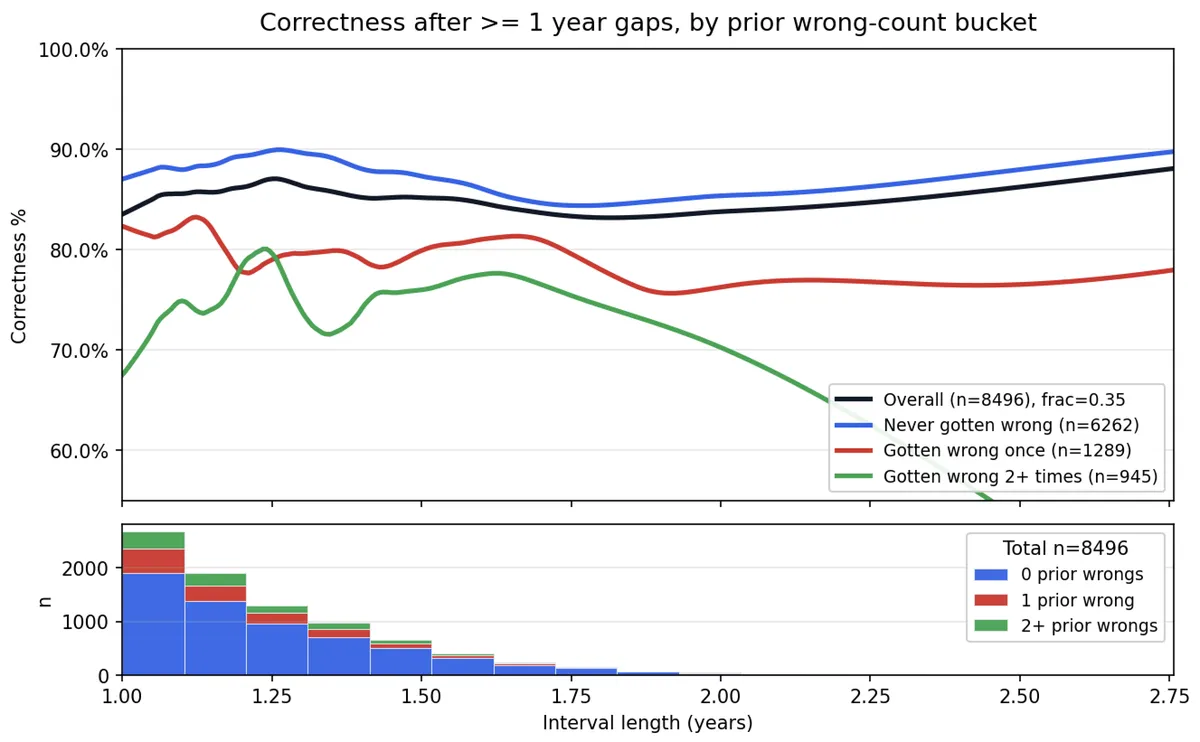
Here's some data. First, here's a LOWESS-smoothed graph of my correctness rate as a function of interval time, for intervals of at least one year. The black line is overall performance; the other three lines give my performance on questions I'd (i) never gotten wrong before, (ii) had gotten wrong only once, and (iii) had gotten wrong at least twice.
Some notes:
- It looks like I'm too aggressive in scheduling long intervals for questions I've gotten wrong several times. This is interesting to me, because my algorithms have already weighted previous performance substantially.
- I had expected the "never wrong" (blue) line to be above 90%, in part because a lot of those are probably quite easy cards. Perhaps I'm too aggressive with those also.
- After I (i) never get a question wrong, (ii) go at least a year without answering the question, (iii) get it wrong, and (iv) answer it at least twice after that, my performance is perfect just about 2/3 of the time (501 of 741).
The most common sequence before a year-or-more interval is exactly seven correct answers (with none incorrect; N=1403). Here's my performance vs. interval on those:
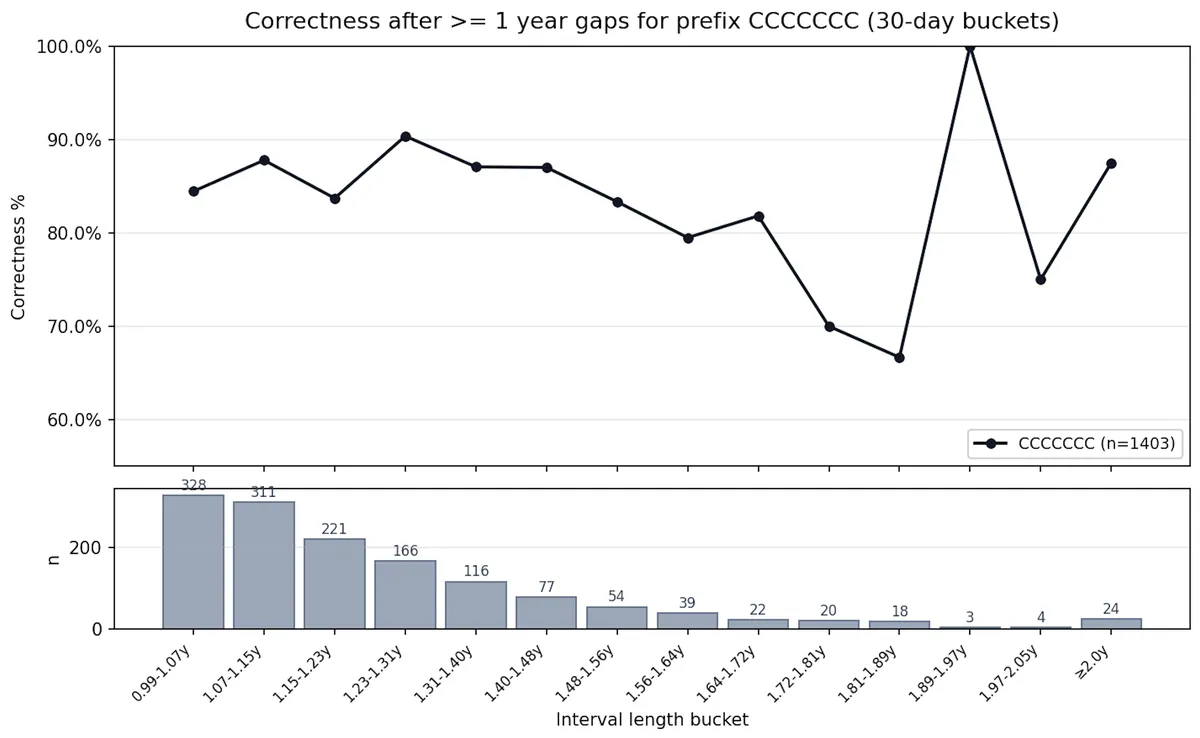
With all the usual caveats (I've changed my algorithm over time, and perhaps my cards systematically vary across time also), this does suggest that little or nothing is gained by waiting only a year instead of a bit longer in this case.